
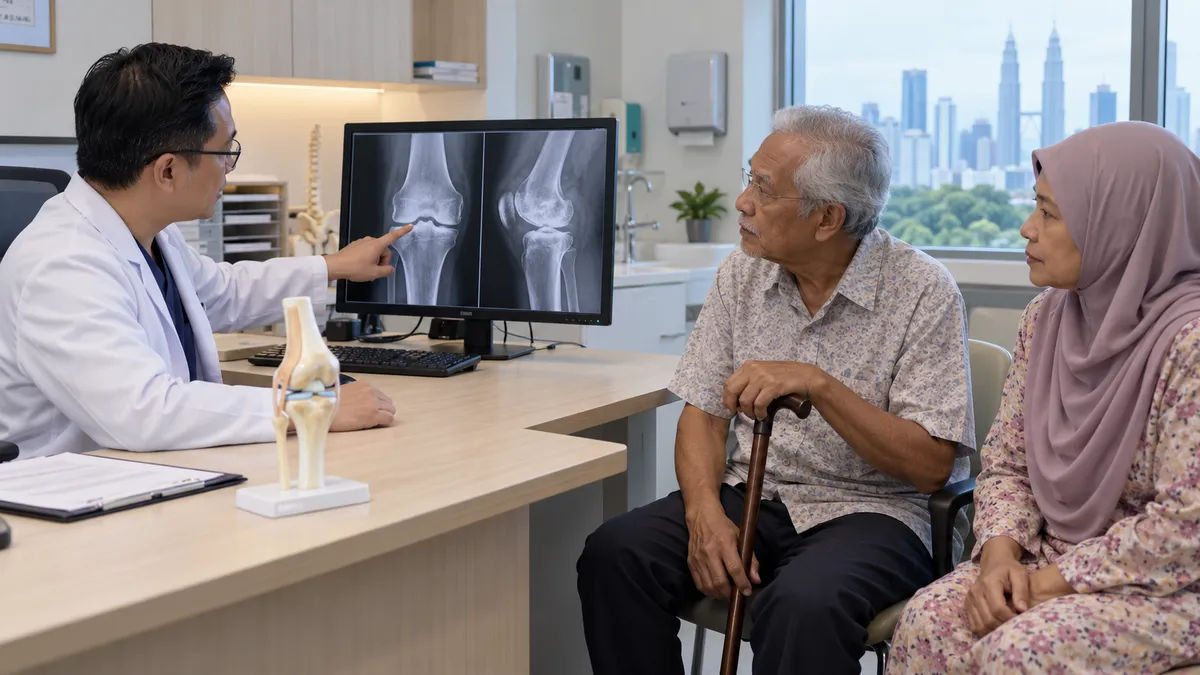
Hearing your doctor describe your knee as “bone on bone” is one of the more alarming phrases in orthopaedic medicine, and it understandably raises urgent questions about what’s actually left to try. This guide explains what this diagnosis genuinely means, what non-surgical options can and cannot realistically achieve at this stage, when surgical referral becomes the appropriate path, and where current research stands.
What “Bone on Bone” Actually Means
This term, while colloquial, refers to a specific, severe stage of osteoarthritis visible on imaging.
On X-ray, this typically corresponds to:
- Kellgren-Lawrence Grade 4, the most severe classification on the standard OA grading scale
- Complete or near-complete loss of joint space, meaning the cartilage that normally cushions the joint has worn away substantially
- Large bone spurs (osteophytes)
- Significant bone remodelling and, in some cases, visible bone-on-bone contact during movement
This is meaningfully different from mild or moderate OA (Grades 1-3), where joint space narrowing is present but cartilage still provides some cushioning. The distinction matters enormously for what treatment options are realistically going to help.
Bone on Bone Knee Arthritis: Function and Pain at This Stage
Bone-on-bone OA typically, though not universally, presents with more significant functional impact than earlier-stage disease:
- Pain that may persist even at rest, not just with activity
- Significant stiffness, particularly after periods of inactivity
- Noticeable grinding or grating sensation (crepitus) during movement
- Reduced range of motion affecting daily activities (stairs, sitting, standing from a chair)
- In some cases, visible joint deformity or instability
It’s worth noting that the correlation between imaging severity and actual symptom severity isn’t perfect, some patients with bone-on-bone imaging report manageable symptoms, while others with less severe imaging report significant pain. Your actual functional limitation and pain matter as much as the imaging grade in guiding treatment decisions.
Why Non-Surgical Options Have Genuine Limitations at This Stage
This is the part that’s often difficult to hear, but important to understand honestly: once cartilage loss is this advanced, non-surgical options generally cannot restore what’s been lost, their role shifts toward symptom management rather than addressing the underlying structural problem.
| Option | Realistic Role at Bone-on-Bone Stage |
| Physiotherapy | Can help maintain surrounding muscle strength and some function, but cannot restore lost cartilage or joint space |
| Weight management | Still valuable for reducing load and pain, but won’t reverse structural damage already present |
| Medication | Can help manage pain, but effectiveness often diminishes as disease severity increases |
| Corticosteroid injections | May provide temporary relief during flare-ups, but benefit is typically shorter-lived at this stage |
| Hyaluronic acid injections | Evidence for benefit at this advanced stage is weaker than for earlier-stage OA |
| PRP/stem cell injections | Evidence specifically for severe, bone-on-bone OA is limited; most positive study results come from mild-to-moderate OA populations |
This doesn’t mean non-surgical measures are worthless at this stage, they can still contribute meaningfully to comfort and function, but it’s important to have realistic expectations about what they can and cannot achieve once cartilage loss is this extensive.
When Surgical Referral Becomes the Appropriate Path
For patients with confirmed bone-on-bone OA and significant, persistent symptoms affecting quality of life, surgical options, most commonly total or partial knee replacement, generally offer the strongest, most reliable evidence for meaningful improvement.
Surgical referral is generally appropriate when:
- Imaging confirms advanced, severe joint space loss
- Pain and functional limitation significantly affect daily life and activities you value
- Conservative measures have been tried and provide inadequate or only temporary relief
- You and your doctor agree the burden of ongoing symptoms outweighs the burden of surgery and recovery
Knee replacement surgery has decades of outcome data supporting significant pain relief and functional improvement for appropriately selected patients with advanced OA. Delaying a clearly indicated surgery indefinitely in favour of unproven alternatives isn’t typically in a patient’s best interest once the disease has reached this stage.
Research Limits Specific to Advanced OA
It’s worth being direct about where regenerative research actually stands for this specific, more severe category of knee OA, since marketing sometimes blurs this distinction.
What’s important to understand:
- Most positive stem cell and PRP research findings come from studies of mild-to-moderate OA populations, not bone-on-bone, Grade 4 disease
- The biological rationale for cell-based cartilage regeneration becomes considerably more challenging once cartilage loss is this extensive, there’s simply less remaining tissue structure to work with
- No current evidence supports stem cell therapy as a reliable alternative to knee replacement for confirmed bone-on-bone OA
- Patients with this severity of disease considering stem cell therapy should understand that the evidence supporting its use is considerably weaker for their specific situation than for earlier-stage disease
Being told honestly that your specific stage of disease isn’t a strong evidence match for a particular treatment is more useful than a hopeful but unsupported recommendation.
A Realistic Decision Framework for Bone on Bone Knee Arthritis
| Question | Why It Matters |
| Does my imaging confirm Grade 4, bone-on-bone changes? | Establishes the actual severity you’re working with |
| How significantly is this affecting my daily function and quality of life? | Determines urgency of addressing the underlying problem, not just managing symptoms |
| Have I had a fair trial of conservative measures already? | Clarifies whether further conservative options are likely to add meaningful value |
| What does my orthopaedic surgeon say about surgical candidacy? | Surgical fitness and suitability varies by individual health factors |
| Am I being realistic about what any non-surgical option can achieve at this stage? | Prevents delaying appropriate treatment based on unrealistic expectations |
Preparing for Bone on Bone Knee Arthritis Surgical Consultation
If you’re moving toward a surgical referral, a few things help make that consultation more productive:
- Bring all recent imaging, not just the most recent X-ray, so the surgeon can see your progression over time
- Document your functional limitations specifically, which daily activities are affected and how
- List conservative treatments already tried, including how long each was attempted and the result
- Prepare questions about recovery, including expected timeline, rehabilitation requirements, and realistic return-to-activity expectations
- Discuss any health conditions that might affect surgical candidacy or recovery, so these can be addressed proactively
Going in prepared generally leads to a more substantive, specific conversation about your actual options rather than a generic overview.
Frequently Asked Questions
Can bone-on-bone knee arthritis be reversed without surgery?
No current treatment, conservative or regenerative, reliably reverses this degree of established cartilage loss. Management at this stage focuses on symptom control or surgical correction.
Is stem cell therapy a reasonable alternative to knee replacement at this stage?
Current evidence doesn’t support this. Most positive stem cell research comes from milder OA; evidence specifically for bone-on-bone disease is limited and inconsistent.
Will physiotherapy still help even with bone-on-bone arthritis?
Yes, for maintaining strength and function, but it cannot restore lost cartilage or joint space at this advanced stage.
How do I know if I’m a good candidate for knee replacement?
This depends on overall health, activity goals, and the severity of your symptoms relative to imaging findings. An orthopaedic surgeon assessment is the appropriate next step.
Should I keep trying injections before considering surgery?
This depends on your specific situation. Injections may still offer some temporary relief, but shouldn’t indefinitely delay surgery if it’s genuinely indicated and symptoms remain significant.
Is there any point getting a second opinion if I’m told I need surgery?
Yes, a second opinion is always a reasonable step for a major surgical decision, particularly to confirm imaging interpretation and discuss all realistic options.
Discuss Your Knee With Our Team
If you have confirmed advanced knee OA and want an honest conversation about what current research can and cannot realistically offer for your specific situation, request an assessment. Learn more about knee osteoarthritis at 23C Regen.