
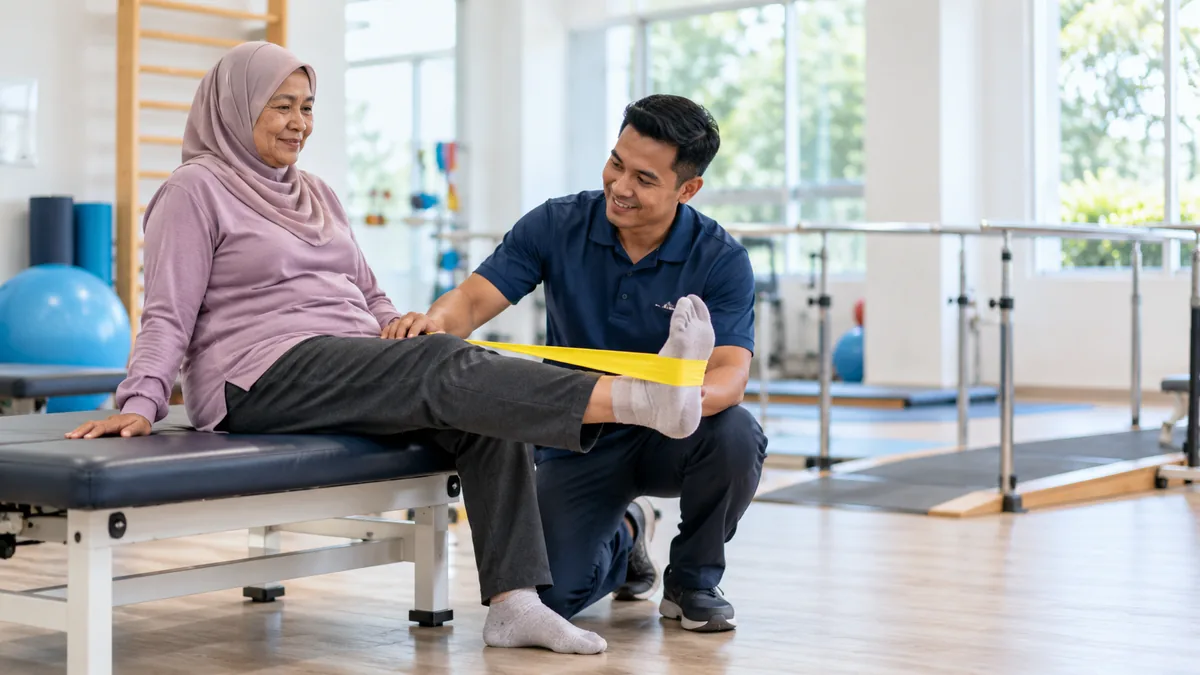
If you have knee osteoarthritis and have been told surgery may be needed one day, it is natural to ask whether physiotherapy can push that day back. The honest answer is that physiotherapy reliably improves pain and function, and for many people this makes surgery less urgent. It cannot rebuild worn cartilage, so it does not suit everyone, and it does not replace an orthopaedic opinion.
What the Evidence Supports Physiotherapy
Exercise therapy is a core, guideline-recommended treatment for knee osteoarthritis. Research consistently shows that structured exercise can reduce pain and improve walking, stair climbing and daily function. Some people who commit to supervised exercise, education and weight management find they feel well enough to postpone surgery. What is less certain is how long that delay lasts, because it depends on how advanced the joint is and how the knee changes over time.
In other words, physiotherapy is best seen as a way to improve how you function now, with a possible secondary benefit of buying time.
What Physiotherapy Cannot Do
- It does not regrow lost cartilage or reverse joint space narrowing
- It cannot correct significant deformity or ligament instability
- It is less likely to control symptoms in severe, bone-on-bone disease; see bone on bone knee arthritis treatment decisions
- It works only if the programme is followed consistently
Components of an Effective Programme
| Component | Purpose | Examples |
| Strength training | Supports the joint and reduces load on it | Quadriceps, hamstring, hip and calf exercises |
| Aerobic exercise | Improves fitness, weight control and mood | Stationary cycling, swimming, brisk walking |
| Balance and movement control | Reduces falls and improves stability | Single-leg standing, step-ups |
| Flexibility and mobility | Maintains range of movement | Gentle stretching and range-of-motion work |
| Education and pacing | Helps you manage flare-ups sensibly | Activity planning, pain monitoring |
| Manual therapy or taping | May ease symptoms short term | Used alongside exercise, not alone |
Activity Modification for
Changing how you move is often as helpful as adding exercise. Practical adjustments include:
- Spreading activity through the day instead of one long, painful session
- Choosing lower-impact options such as cycling or swimming over running or jumping
- Reducing repeated deep squatting, kneeling and long stair climbing when they flare symptoms
- Using a walking aid or supportive footwear when advised
- Staying active, since complete rest tends to weaken muscles and stiffen the joint
Supervised Therapy vs Home Exercise
Supervised physiotherapy usually works better at the start because a therapist can assess your knee, set the right level of exercise, correct technique and adjust as you progress. A typical pattern is a series of supervised sessions over several weeks, followed by a home programme you keep up long term. The right frequency depends on your knee and goals, so it should be set by your physiotherapist rather than copied from a general plan.
Weight Management
If you carry extra weight, reducing it is one of the most effective steps for knee pain, because every kilogram adds load through the joint when you walk. Even a modest, sustained reduction can ease symptoms and make exercise more comfortable. Our guide on knee pain treatment without surgery covers the full range of conservative options.
How Long Should You Try Before Deciding?
A fair trial usually means consistent participation for several weeks to a few months, with reassessment at agreed checkpoints. If your function is not improving, or pain is getting worse despite good effort, that is useful information, and a good reason to see an orthopaedic surgeon. Read how long can knee replacement be delayed safely? for the factors that influence timing.
The Role of Joint Lubrication and Biomechanics in Delaying Surgery
Beyond structured exercise and weight management, understanding the underlying biomechanics of the knee joint can provide valuable insight into how conservative care functions. When knee osteoarthritis progresses, the cartilage that cushions the ends of the bones gradually thins, leading to increased friction, localized inflammation, and joint irritation during movement.
Biomechanical optimization focuses on correcting abnormal movement patterns and muscle imbalances that place uneven stress across the joint compartments. Key biomechanical factors include:
- Kinetic Chain Correction: Strengthening weak hip abductors and stretching tight calves to prevent altered gaits that force specific compartments of the knee to absorb excessive impact.
- Synovial Fluid Stimulation: Promoting the production and circulation of the body’s natural joint lubricant through regular movement, which helps cartilage absorb essential nutrients since it lacks a direct blood supply.
- Mitigating Inactivity Risks: Counteracting the effects of prolonged rest, which slows synovial fluid exchange and paradoxically accelerates joint stiffness and cartilage degradation.
By maintaining controlled, low-impact motion through guided physical therapy, patients can protect the internal environment of the knee. While this process cannot reverse structural damage or recreate lost tissue, optimizing joint mechanics significantly reduces daily irritation and improves functional capacity, making the prospect of delaying joint replacement surgery a realistic outcome for those managing early to moderate osteoarthritis.
Signs Surgery May Need Discussion
- Pain that keeps you awake at night or is present at rest
- Falling or giving way
- Growing difficulty walking short distances
- Progressive deformity
- Little or no improvement after a proper, consistent trial of conservative care
Frequently Asked Questions
Can physiotherapy avoid knee replacement completely?
For some people with mild to moderate osteoarthritis it can postpone or even avoid surgery, but this cannot be promised, especially in advanced disease.
How often should I do knee exercises?
This depends on your knee and programme. Your physiotherapist will set a schedule, usually combining supervised sessions with regular home exercise.
Is exercise safe if my knee hurts?
Mild discomfort during exercise is common and usually acceptable. Sharp, worsening or lasting pain should be discussed with your physiotherapist.
Does physiotherapy work for bone-on-bone knees?
It can still improve strength and function, but benefits are usually more limited, and surgery is often discussed alongside it.
Who should I see first?
Start with a doctor or orthopaedic surgeon for diagnosis and imaging, then a physiotherapist for a programme matched to your knee.
If you would like to talk through your records and options, you can contact our team or read about knee osteoarthritis at 23C Regen.
This article is general information, not medical advice or a substitute for ordering tests through your own doctor. Consult with our team for proper assessment.