
Medically reviewed by Dr Abdul Farid bin Rahmathulla, Medical Doctor, 23C Life Science Centre · Last reviewed 3 November 2026
The best exercises for knee osteoarthritis are the ones that build strength in the muscles around the knee without pounding the joint. That means leg strengthening, walking, cycling and swimming or water exercise. Done a few times a week, they usually ease pain and make stairs and getting up off the floor less of a chore. Most people get the dose wrong, either doing nothing because it hurts or doing too much and flaring up, so that’s what this page sorts out.
Does exercise really help knee osteoarthritis?
Yes, and it’s less of a “maybe” than most people expect. Knee pain is common here. A PLoS One survey of 1,226 adults aged 55 and above in Greater Kuala Lumpur found that about a third reported knee pain. A 2024 Cochrane review pooled 139 trials with more than 12,000 people and found that exercise improved knee pain and physical function compared with no treatment or usual care. Its authors were also upfront that the size of the benefit is modest, and that many trials weren’t blinded, which can flatter the results. So exercise isn’t magic. It’s just one of the few things with reasonable evidence, no big side effects and a price tag of nearly zero.
That’s why the major guidelines put it first. Both the American College of Rheumatology and the OARSI guidelines list exercise and weight management as the foundation of treatment, before tablets or injections.
It also makes sense in a plain, mechanical way. The thigh muscles act like shock absorbers. When they’re weak, the joint takes more of the load. Strengthen them and the same knee often feels better, even when the X-ray stays exactly the same.
Best knee osteoarthritis exercises to do at home
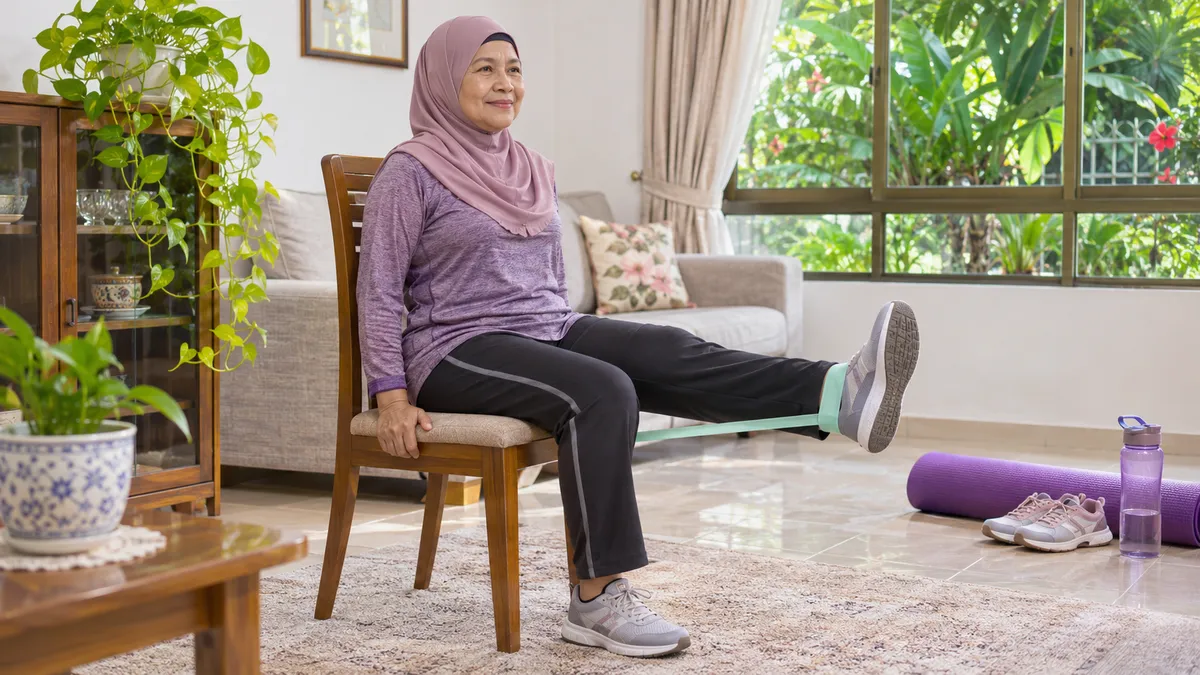
You don’t need a gym or any equipment. A chair, a wall and a low step are enough. Go slowly, breathe normally and stop a rep short of the point where the knee really complains.
| Exercise | How to do it | Starting dose |
| Sit-to-stand | Sit on a firm chair, stand up without using your hands, then lower slowly | 8 to 10 reps, 2 sets |
| Straight leg raise | Lie on your back, bend one knee, lift the straight leg to the height of the bent knee, hold for 2 seconds | 10 reps each leg, 2 sets |
| Glute bridge | Lie on your back, knees bent, push through your heels and lift your hips | 10 reps, 2 sets |
| Heel raise | Hold a counter or wall, rise onto your toes, lower slowly | 10 to 12 reps, 2 sets |
| Standing hamstring curl | Hold a chair, bend one knee and bring your heel toward your bottom, then lower | 10 reps each leg, 2 sets |
| Low step-up | Step onto the bottom stair with one foot, bring the other up, step down slowly | 8 reps each leg, 2 sets |
| Side-lying leg lift | Lie on your side, lift the top leg straight up, lower slowly | 10 reps each leg, 2 sets |
A few notes that make a real difference:
- Sit-to-stand is the star. It copies what you do every day, from getting off the toilet to getting up from a prayer mat, and it trains the front of the thigh, the hips and the glutes in one go.
- Slow lowering counts. Taking three seconds to sit down works the muscles harder than standing up does.
- Start easier than you think. If 8 reps feels like a lot, do 5. You can build from there over a few weeks.
- Keep the knee tracking over your toes. If it collapses inward, shorten the movement until it stays lined up.
If you’re not sure your form is right, it’s worth a session or two with a physiotherapist. They can adjust the routine for a stiff hip, a weak ankle or an old injury, which a general article can’t do.
Low-impact cardio that suits sore knees
Strengthening is half the job. The other half is moving the knee through regular, gentle repetition, which helps keep the joint lubricated and the body fit.
- Walking. Flat ground, supportive shoes, 10 to 20 minutes to start. Early morning or evening works in Malaysia’s heat, and a mall or covered walkway is a fair backup on rainy days.
- Stationary or outdoor cycling. Easy on the joint because your weight is supported. Set the seat high enough that the knee doesn’t bend sharply at the top of the pedal stroke.
- Swimming and water exercise. Water takes load off the knee, so it’s a good choice if walking hurts too much. Many condo pools and community pools run water exercise classes.
- Tai chi. Slow, controlled movement that builds balance and leg strength. The OARSI guidelines include mind-body exercise among their recommendations for knee osteoarthritis.
If you also live with type 2 diabetes, regular movement helps there too, so your knee routine may be doing double duty.
How often should you do knee exercises?
A good starting pattern looks like this:
| What | How often |
| Strengthening exercises | 2 to 3 non-consecutive days a week |
| Walking, cycling or swimming | 3 to 5 days a week, 10 to 30 minutes |
| Gentle range-of-motion moves | Daily, particularly in the morning |
Give it about 6 to 8 weeks before judging. Strength builds gradually, and most people feel the difference in daily tasks (stairs, getting out of a car) before they feel it in pain. If you stop, the gains fade, so think of it as upkeep rather than a course you finish.
How much pain is okay when you exercise?
This is the question that stops most people, and the answer is more relaxed than you’d think. Mild to moderate discomfort during exercise is common and isn’t a sign you’re damaging the joint. The thing to watch is how the knee behaves afterwards.
- Green: mild aching that eases within an hour or so. Carry on.
- Amber: more pain or swelling that lasts until the next morning. Cut the reps or the intensity by about a third next time.
- Red: sharp pain, locking, giving way, or obvious swelling that doesn’t settle. Stop and get it checked.
See a doctor urgently if your knee suddenly swells up hot and red, you have a fever, you can’t put weight on the leg, or you notice calf pain and swelling.
Exercises to go easy on
Not banned, just worth watching:
- Deep squats and full lunges, especially if they pinch at the front of the knee
- Running and jumping on hard surfaces
- Long stretches of stairs or hill climbing on a flare-up day
- Kneeling or sitting cross-legged on the floor for long periods
If you need to sit on the floor for prayers or family gatherings, a low stool or a cushion under the hips often takes pressure off. Small tweaks beat avoiding things you love.
Does the stage of knee osteoarthritis change what you should do?
A bit. In the early stages, you can usually push the strengthening harder. Knowing which grade your X-ray shows helps you and your physio set the intensity, and the stages of knee osteoarthritis explained from grade 1 to 4 lay out what each one tends to feel like. When the joint is more worn, the plan leans toward water exercise, cycling and shorter, lighter sessions, and the aim becomes comfort and keeping you moving.
When exercise alone isn’t enough
Sometimes you do everything right and the knee still hurts. That doesn’t mean the exercise failed. It means the knee may need extra help while you keep building strength.
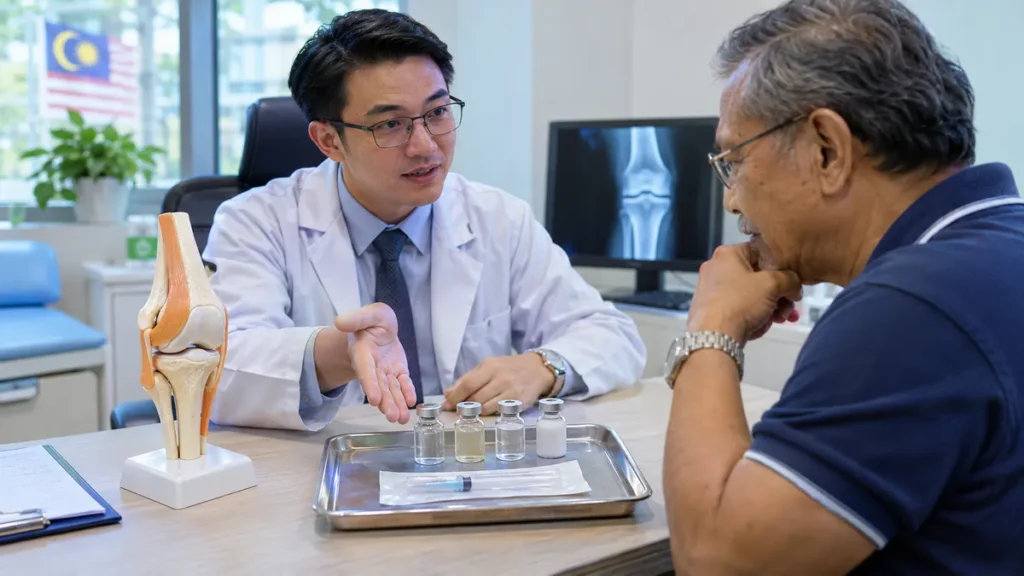
Options include a pain-relief plan from your doctor, a course of injections such as steroid, hyaluronic acid or PRP to quiet a bad stretch so you can keep training, or in some cases an assessment for mesenchymal stem cell treatment. The evidence for stem cells in knee osteoarthritis is still early and mixed, and no one can promise a result, so it’s worth reading what’s known on clinical evidence and safety before you decide. Plenty of people use a combination of these along with regular exercise as a way of putting off a knee replacement for as long as they sensibly can.
If the pain is long-running and spreading beyond the knee, it may also be worth looking at how ongoing pain is being managed overall, since sleep, mood and stress all turn the volume up or down.
Frequently Asked Questions
What is the best exercise for knee osteoarthritis?
There isn’t one single best exercise, but strengthening the thigh and hip muscles gives the most dependable results. Sit-to-stand, straight leg raises and glute bridges are good places to start, combined with low-impact cardio like walking, cycling or swimming. A physiotherapist can tailor the mix to your knee.
Is walking good for knee osteoarthritis?
Yes, for most people. Walking on flat ground in supportive shoes keeps the joint moving and helps with weight control and fitness. Start with 10 to 20 minutes and build gradually. If walking flares the knee, switch to cycling or water exercise for a while and ease back in.
Should I exercise through knee pain?
Mild to moderate discomfort that settles within about an hour is usually fine. Sharp pain, locking, giving way, or swelling that lasts until the next day means you should back off. If pain keeps getting worse, get your knee osteoarthritis assessed rather than pushing on.
Can exercise reverse knee osteoarthritis?
No, exercise can’t regrow worn cartilage. What it can do is reduce pain, improve how the knee works and slow the rate at which things feel worse, mainly by taking load off the joint through stronger muscles. Those gains are real, even when the X-ray doesn’t change.
Are squats bad for knee osteoarthritis?
Not automatically. Partial squats within a comfortable range are fine for many people and train the same muscles as sit-to-stand. Deep squats can aggravate a sore knee, so start shallow and stop where the pain starts. Sit-to-stand is a safer stand-in.
How long until knee exercises start working?
Most people notice small improvements in stairs and walking in about 6 to 8 weeks of steady practice, 2 to 3 times a week. Results vary, and the gains fade if you stop. Sticking with a routine matters more than pushing hard in any single session.
Can I exercise if I’m planning an injection or stem cell treatment?
Usually yes, and doing so often helps. Strong leg muscles support any treatment. Your doctor will tell you what to avoid in the days after an injection. The assessment process at the clinic covers what to expect before and after, and what activity is sensible while you recover.
Want a plan built around your knee?
Generic routines only go so far. An assessment looks at your X-ray, your pain pattern and your daily life, then tells you which exercises, treatments and next steps make sense for you. Book an assessment and the team will take you through it.
This article is for general information and isn’t medical advice. Talk to your doctor or physiotherapist about your own knee before starting or changing an exercise programme. Results vary from person to person and no outcome is guaranteed.
References
- Mat S, Jaafar MH, Ng CT, et al. Ethnic differences in the prevalence, socioeconomic and health related risk factors of knee pain and osteoarthritis symptoms in older Malaysians. PLoS One. 2019;14(11):e0225075. https://pmc.ncbi.nlm.nih.gov/articles/PMC6874060
- Lawford BJ, Hall M, Hinman RS, et al. Exercise for osteoarthritis of the knee. Cochrane Database Syst Rev. 2024;12. https://www.cochrane.org/evidence/CD004376
- Kolasinski SL, Neogi T, Hochberg MC, et al. 2019 American College of Rheumatology/Arthritis Foundation guideline for the management of osteoarthritis of the hand, hip, and knee. Arthritis Care Res. 2020;72(2):149-162. https://doi.org/10.1002/acr.24131
- Bannuru RR, Osani MC, Vaysbrot EE, et al. OARSI guidelines for the non-surgical management of knee, hip, and polyarticular osteoarthritis. Osteoarthritis Cartilage. 2019;27(11):1578-1589. https://wrap.warwick.ac.uk/125416/