
Medically reviewed by Dr Abdul Farid bin Rahmathulla, Medical Doctor, 23C Life Science Centre · Last reviewed 3 November 2026
Knee osteoarthritis stages are usually described on a scale of grade 1 to grade 4, based on how much the joint has changed on an X-ray. Grade 1 is barely visible wear. Grade 4 is severe damage, with the cushioning space almost gone. How bad your knee feels doesn’t always match the grade, so the number is only one part of the picture.
What are the 4 stages of knee osteoarthritis?
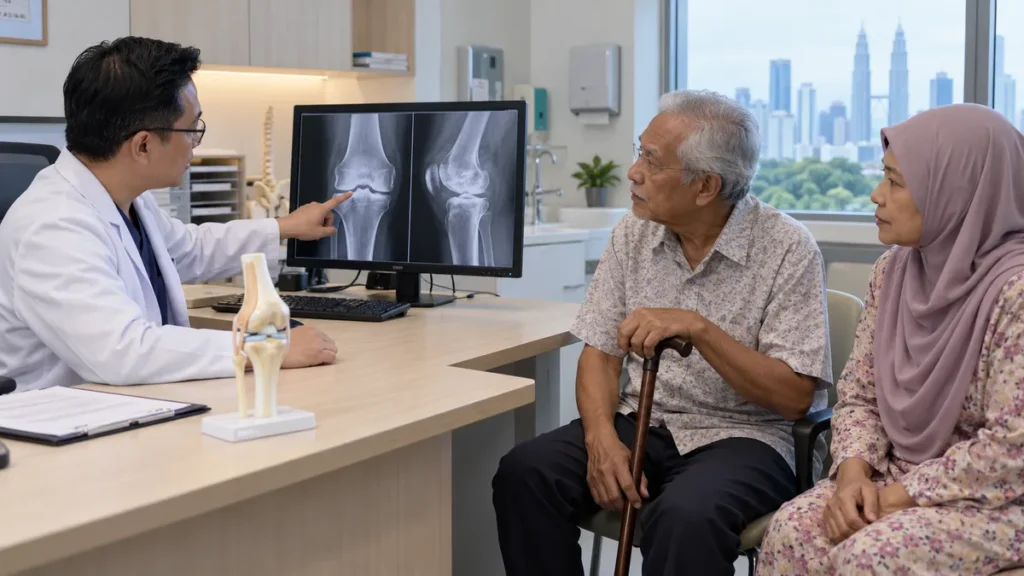
Most doctors in Malaysia use the Kellgren-Lawrence system, which has been around since the 1950s. It looks at a standing X-ray and checks for bone spurs (osteophytes), narrowing of the gap between the thigh bone and shin bone, hardening of the bone and any change in shape. Some clinics say “stage” and others say “grade”, but they mean the same scale.
Here’s how the four grades compare.
| Grade | What the X-ray shows | What many people feel | What usually helps |
| 1 (doubtful) | Possible tiny bone spurs, joint gap looks about normal | Mild stiffness after sitting, little or no pain | Weight control, strengthening, activity changes |
| 2 (mild) | Clear bone spurs, gap may be slightly narrower | Aching after walking or stairs, morning stiffness | Physio, weight loss, pain relief as needed, bracing |
| 3 (moderate) | Several bone spurs, definite narrowing, some hardening of bone | Regular pain, swelling, clicking, trouble with stairs and squatting | A mix of exercise, injections and specialist review |
| 4 (severe) | Large bone spurs, marked narrowing, severe hardening, visible deformity | Constant pain, stiffness, pain at night, a knee that gives way | Specialist-led plan, often including surgery talks |
None of this replaces a proper assessment. An X-ray is a snapshot, and two people with the same grade can live very differently with it.
Grade 1 knee osteoarthritis: the quiet stage
At grade 1, the X-ray is nearly normal. A doctor may see a hint of a bone spur and a joint gap that is only doubtfully narrower. Plenty of people at this stage have no pain at all, and the finding turns up by accident on a scan done for something else.
When there are symptoms, they’re small. Your knee feels tight when you first stand up. It clicks a bit on stairs. A long day on your feet leaves it achy by evening.
This is the best time to work on the things that matter most for knee osteoarthritis in the long run. Leg strength, a healthier weight and regular movement all take load off the joint, and the best exercises for knee osteoarthritis are simple enough to start at home this week. A lot of people skip this stage because it doesn’t hurt enough to worry them, which is a pity, since it’s the easiest stage to act on.
Grade 2 knee osteoarthritis: early but real
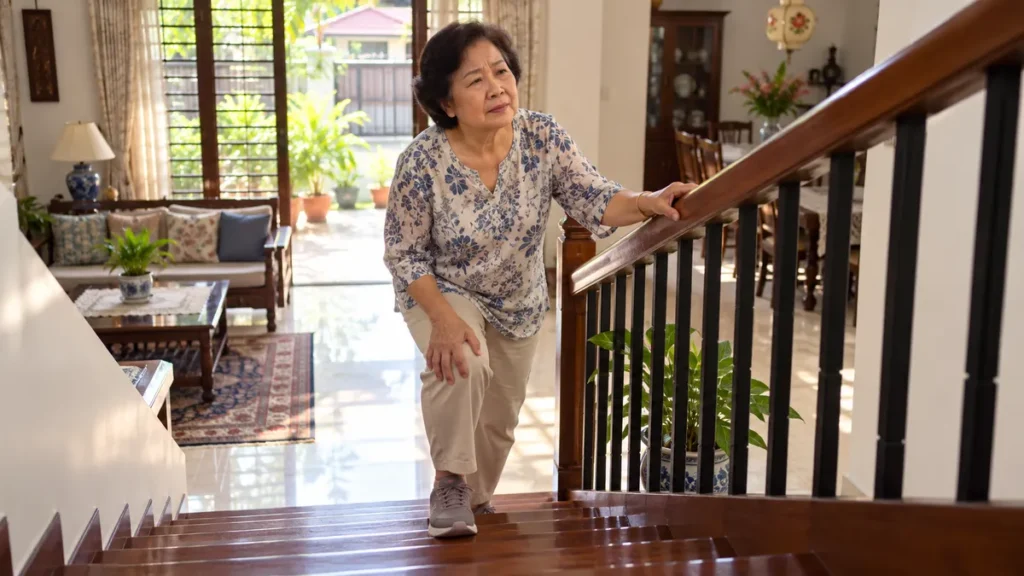
At grade 2, the bone spurs are definite and the joint space may be starting to narrow. This is when most people first notice a pattern. The knee hurts after a long walk, a trip to the pasar malam or a few flights of stairs. It stiffens up after sitting through a long meeting or a movie, then loosens up after a few steps.
Pain tends to come and go. You’ll have good weeks and bad ones, and flare-ups often follow a heavier day or a change in routine.
The basics carry the most weight here. The American College of Rheumatology and the Arthritis Foundation’s guideline lists exercise and weight management as core treatment at every grade. A physiotherapist can build a plan around your own knee. Simple pain relief, a knee brace for long days out and footwear changes can fill in the gaps. Many people stay in this stage for years, particularly when they keep their legs strong.
If you’re already wondering how far you can push things before surgery enters the conversation, there’s an honest look at the evidence for each option in the rundown of ways to delay a knee replacement.
Grade 3 knee osteoarthritis: moderate damage
Grade 3 is where daily life starts to get affected. The X-ray shows several bone spurs, a clearly narrower joint gap and some hardening of the bone beneath the cartilage. The shape of the joint may be beginning to change.
Typical complaints at this stage:
- Pain on most days, not only after activity
- Swelling that comes back after walking
- Grinding, clicking or catching inside the knee
- Trouble squatting, kneeling or sitting on the floor, which matters a lot in many Malaysian homes and surau
- A knee that feels weak or stiff first thing in the morning for more than half an hour
This is often the stage where people start hearing about knee injections such as steroid, hyaluronic acid, PRP and stem cells, because exercise and tablets alone no longer feel like enough. Each one suits a different person and has a different level of evidence behind it.
On stem cells specifically, a systematic review and meta-analysis of intra-articular mesenchymal stem cell injections shows the research is still early and the results are mixed, so nobody can promise a particular result. Some people with grade 2 and grade 3 knees are assessed for mesenchymal stem cell treatment alongside the usual exercise and weight work. Whether you’re a fit depends on your scan, your history and what you’re hoping to get out of it.
Grade 4 knee osteoarthritis: severe stage
Grade 4 means large bone spurs, marked narrowing and clear deformity of the joint. At this point the cartilage is mostly gone in the worn areas, and bone is rubbing on bone.
Pain is often constant, including at night. The knee may look bowed or swollen, feel unstable and cut your walking distance to a few minutes. Many people avoid going out and get less active, which can weaken the leg further.
Treatment at grade 4 knee osteoarthritis usually shifts toward specialist-led options, and a knee replacement is often part of that discussion, particularly when pain and function are badly affected. Injections and other non-surgical measures can still ease symptoms for some people, but they can’t rebuild a joint that has worn down this far. Anyone who tells you otherwise is overselling.
Does the stage match how much pain you have?
Not neatly. This surprises a lot of people, and it’s one of the main reasons the grade shouldn’t be treated as a verdict.
Some people have grade 3 changes and manage fine. Others have grade 2 on the X-ray and a lot of pain. Muscle strength, body weight, sleep, mood, past injuries and how much you move all affect how a knee feels, and none of them show up on the film.
A PLoS One survey of 1,226 adults aged 55 and above in Greater Kuala Lumpur found that about a third reported knee pain, and around a quarter had symptoms in line with knee osteoarthritis. Women and people with obesity were more likely to be affected. So it isn’t unusual, and it isn’t something you have to quietly put up with.
Can knee osteoarthritis stages be reversed?
Worn cartilage doesn’t grow back on its own, and no treatment has been proven to restore a grade 4 joint to normal. What you can do is slow things down, ease symptoms and keep the knee working.
The earlier you act, the more options you tend to have. People who start at grade 1 or 2 usually have more choice than those who wait until grade 3 or 4. That said, it’s never too late to improve how a knee feels and moves, even when the X-ray looks rough.
When should you see a doctor about your knee?
Get it checked if:
- Knee pain lasts more than a few weeks
- Your knee swells, locks or gives way
- Pain wakes you at night
- You’re avoiding stairs, prayer, work or family outings because of it
- You have sudden swelling with heat and redness, or a fever (see a doctor urgently)
A doctor can arrange an X-ray, work out your grade and rule out other causes such as gout or an old ligament injury. If you’d like to see how a stem cell assessment works at the clinic, the step-by-step process lays out what happens from the first consultation to the follow-up.
Frequently Asked Questions
What are the stages of knee osteoarthritis?
Doctors usually grade knee osteoarthritis from 1 to 4 using the Kellgren-Lawrence scale. Grade 1 is doubtful, grade 2 is mild, grade 3 is moderate and grade 4 is severe. The grade is based on bone spurs and joint space narrowing on a standing X-ray, so symptoms and the grade don’t always line up.
How fast does knee osteoarthritis progress from grade 1 to grade 4?
There’s no fixed timeline. Some people stay at grade 2 for ten years or more, while others progress faster, especially after an injury or with extra body weight. Keeping your legs strong and your weight in check tends to slow things down. Your doctor can compare X-rays over time to see how yours is moving.
Is grade 3 knee osteoarthritis bad?
Grade 3 is moderate. Daily life is often affected, with regular pain, swelling and trouble on stairs. It isn’t the end of the road, though. Many people at this stage still do well with exercise, weight control and knee injections, and surgery isn’t automatic. A specialist can talk you through the options that fit.
What is the best treatment for grade 4 knee osteoarthritis?
For severe damage, treatment usually involves a specialist and often a discussion about knee replacement, especially when pain and mobility are badly hit. Non-surgical options may ease symptoms for some people but can’t restore worn bone. Details on this stage are covered in the grade 4 knee osteoarthritis treatment options.
Can stem cells help knee osteoarthritis at any stage?
The evidence is early and mixed, and results vary from person to person. Stem cell treatment is generally looked at for earlier or moderate stages rather than severe, bone-on-bone knees. There are no guarantees. The clinical evidence and safety information explains what is known so far.
Does knee osteoarthritis always need surgery?
No. Plenty of people never need surgery, especially when they start looking after the knee early. Surgery tends to come up when pain and loss of function stay bad despite proper non-surgical care, which is more common at grade 4. Your doctor will weigh your age, health and goals.
Is knee osteoarthritis the same as knee pain from ageing?
Not exactly. Ageing is a risk factor, but osteoarthritis is a joint condition that can also follow injury, extra weight or repeated stress, and it can show up before 50. Knee pain can also come from other causes such as gout, a meniscus tear or ligament injury, which is why a proper check matters.
Not sure which stage your knee is at?
A proper assessment looks at your X-ray, your symptoms and your daily routine, then tells you where your knee stands and which options are realistic for you. Book an assessment and the team will go through your results with you.
This article is for general information and isn’t medical advice. Talk to your doctor about your own knee before starting or changing any treatment. Results from any treatment vary, and no outcome is guaranteed.
References
- Mat S, Jaafar MH, Ng CT, et al. Ethnic differences in the prevalence, socioeconomic and health related risk factors of knee pain and osteoarthritis symptoms in older Malaysians. PLoS One. 2019;14(11):e0225075. https://pmc.ncbi.nlm.nih.gov/articles/PMC6874060
- Kellgren JH, Lawrence JS. Radiological assessment of osteo-arthrosis. Ann Rheum Dis. 1957;16(4):494-502. https://pmc.ncbi.nlm.nih.gov/articles/1006995
- Radiopaedia. Osteoarthritis of the knee: Kellgren-Lawrence grading. https://images.radiopaedia.org/cases/27042/discussion?lang=us
- Kolasinski SL, Neogi T, Hochberg MC, et al. 2019 American College of Rheumatology/Arthritis Foundation guideline for the management of osteoarthritis of the hand, hip, and knee. Arthritis Care Res. 2020;72(2):149-162. https://doi.org/10.1002/acr.24131
- Efficacy and safety of intra-articular injection of mesenchymal stem cells in the treatment of knee osteoarthritis: a systematic review and meta-analysis. https://www.ncbi.nlm.nih.gov/pmc/articles/PMC7717742/