

Medically reviewed by Dr Abdul Farid bin Rahmathulla, Medical Doctor, 23C Life Science Centre · Last reviewed 3 October 2026
These three terms often get used almost interchangeably in casual conversation, but they describe genuinely different points along a disease spectrum, with very different implications for prognosis and treatment urgency. Understanding where you actually sit on this spectrum matters enormously for knowing what to realistically expect and do next.
MASLD Terminology: Getting the Language Right
Medical terminology for fatty liver disease has shifted in recent years, and understanding current terms helps you make sense of your own reports and research.
| Term | What It Means |
| NAFLD (Non-Alcoholic Fatty Liver Disease) | Older terminology, still commonly used and understood |
| MASLD (Metabolic dysfunction-Associated Steatotic Liver Disease) | Updated, preferred terminology, reflecting the metabolic basis of the condition |
| MASH (Metabolic dysfunction-Associated Steatohepatitis) | A more advanced form involving active liver inflammation and cell damage, previously called NASH |
| Fibrosis | Scarring of liver tissue developing in response to ongoing damage or inflammation |
| Cirrhosis | Advanced, typically permanent scarring that significantly disrupts liver structure and function |
The Disease Progression Spectrum
It helps to think of this as a spectrum, not every stage, where someone sits determines both how urgently things need to be addressed and what’s realistically achievable.
| Stage | What’s Happening | Reversibility |
| Simple steatosis (fatty liver) | Fat accumulation in liver cells, minimal or no inflammation | Often substantially reversible with sustained lifestyle change |
| MASH (with inflammation) | Active inflammation and liver cell damage alongside fat accumulation | Can improve significantly with treatment, though inflammation increases fibrosis risk if untreated |
| Early fibrosis | Scar tissue beginning to form in response to ongoing inflammation | Often improvable, sometimes substantially, with effective treatment of the underlying cause |
| Advanced fibrosis | More extensive scarring, affecting liver architecture | Improvement possible but less complete; underlying cause treatment remains important |
| Cirrhosis | Extensive, typically permanent scarring, significantly disrupting liver structure and function | Generally considered largely irreversible once established, though progression can often still be slowed |
Not everyone with fatty liver progresses through every stage. Many people with simple steatosis never develop significant fibrosis. The progression depends heavily on ongoing risk factors, the presence of inflammation (MASH versus simple steatosis), and how effectively underlying drivers are managed.
Understanding Fibrosis
Fibrosis is essentially the liver’s scarring response to repeated or ongoing injury, similar in concept to how skin forms a scar after repeated damage, except happening at a microscopic, structural level within liver tissue.
Fibrosis is typically staged (commonly F0 to F4):
- F0: No fibrosis
- F1: Mild fibrosis
- F2: Moderate fibrosis
- F3: Advanced (bridging) fibrosis
- F4: Cirrhosis
This staging, usually assessed through FibroScan (transient elastography), blood-based scoring tools, or occasionally biopsy, is one of the most important pieces of information for understanding where you actually stand and how closely you need to be monitored.
Understanding Cirrhosis
Cirrhosis represents F4, the most advanced stage, where scarring has become extensive enough to significantly disrupt the liver’s normal architecture and function.
Key points about cirrhosis:
- It can result from many underlying causes, viral hepatitis, alcohol, and metabolic (MASLD/MASH) causes among the most common
- Early cirrhosis (compensated) may have few or no symptoms
- Advanced cirrhosis (decompensated) brings complications: jaundice, fluid retention, confusion, bleeding risk
- Cirrhosis significantly raises the risk of liver cancer, making ongoing surveillance essential regardless of cause
- While reversal of established cirrhosis isn’t generally expected, treating the underlying cause can still meaningfully slow further progression and reduce complication risk
Risk Assessment: What Determines Your Trajectory
Several factors influence how likely someone is to progress from fatty liver toward fibrosis and cirrhosis:
| Risk Factor | Relevance |
| Presence of MASH (inflammation) versus simple steatosis | Inflammation is the key driver of fibrosis progression |
| Type 2 diabetes or insulin resistance | Significantly increases progression risk |
| Obesity, particularly central/abdominal | Strong associated risk factor |
| High blood pressure and abnormal cholesterol | Part of the broader metabolic risk picture |
| Alcohol use | Can compound risk even in primarily metabolic-driven liver disease |
| Genetic factors | Some individuals have genetically increased susceptibility to fibrosis progression |
Standard Care at Each Stage
| Stage | Standard Management Focus |
| Simple steatosis | Weight management, dietary change, exercise, managing metabolic risk factors |
| MASH | More intensive metabolic management; certain newer medications increasingly available for eligible patients; closer monitoring |
| Fibrosis (any stage) | Addressing underlying cause aggressively; regular monitoring of fibrosis progression |
| Cirrhosis | Hepatology-led management: treating underlying cause, managing complications, regular liver cancer surveillance, transplant evaluation if advanced |
Across every stage, treating the actual underlying driver, metabolic risk factors, alcohol use, or viral hepatitis, remains the central, evidence-based approach, not any single isolated intervention.
Why Knowing Your Exact Stage Matters
Two people might both say “I have fatty liver” and be in completely different situations, one with simple steatosis needing lifestyle changes and periodic monitoring, another with advanced fibrosis needing closer hepatology involvement and cancer surveillance. This is why getting a proper fibrosis assessment, not just a general fatty liver diagnosis, matters so much for understanding your actual risk and appropriate monitoring plan.
Practical Steps If You’ve Just Been Diagnosed With Fatty Liver
Receiving a fatty liver diagnosis, at any stage, is a useful early signal rather than cause for panic, provided it prompts action. Reasonable first steps include:
- Ask specifically what stage you’re at, not just that fatty liver was found, since this changes the urgency and approach significantly
- Request fibrosis assessment if it hasn’t already been done, through FibroScan or a blood-based scoring tool
- Review your metabolic risk factors with your doctor, including blood sugar, blood pressure, and cholesterol
- Set a realistic, sustainable weight management goal if relevant, rather than an aggressive, unsustainable one
- Schedule follow-up monitoring, so progression or improvement can be tracked over time rather than assumed
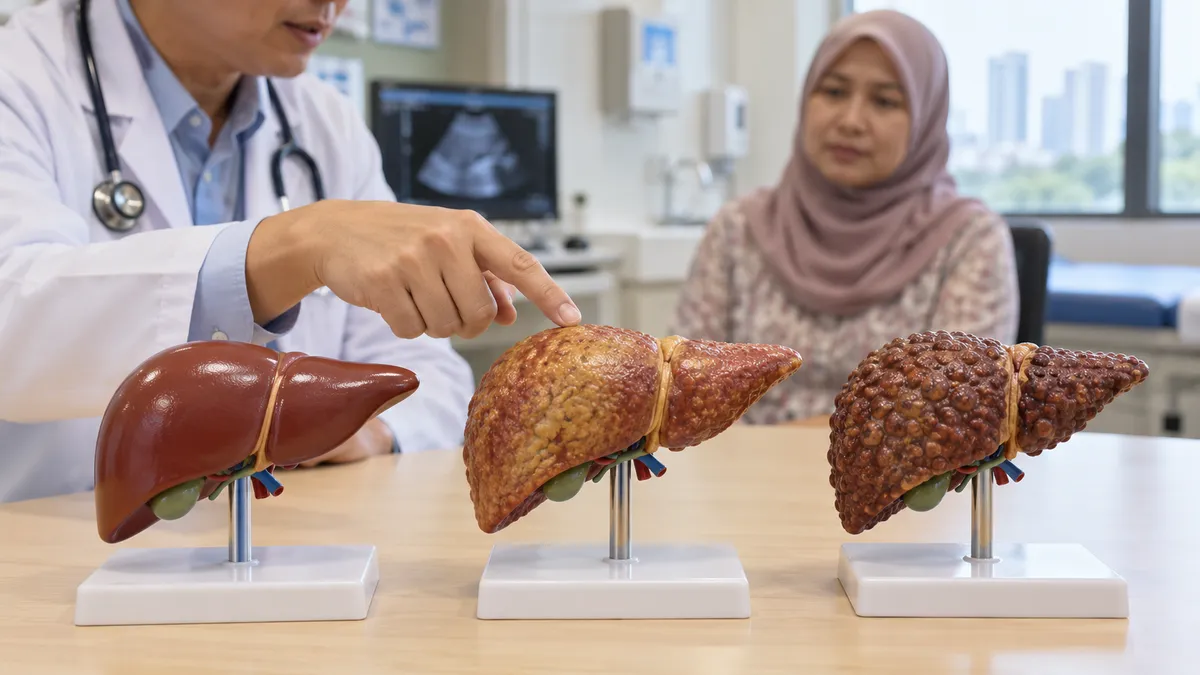
The Progression of Fatty Liver: From Steatosis to Fibrosis & Cirrhosis
Fatty liver disease follows a clear histopathological continuum that progresses from simple fat accumulation (steatosis) to inflammatory injury, progressive scar tissue deposition (fibrosis), and ultimately permanent structural scarring (cirrhosis). Recognizing where a patient sits along this spectrum is vital for reversing disease progression before permanent parenchymal changes set in.
Clinical Stages of Progressive Fatty Liver Disease
- Simple Steatosis (Fat Accumulation): Excess triglycerides accumulate within more than 5% of hepatocytes without initiating significant cellular inflammation or tissue necrosis.
- Steatohepatitis (MASH): Lipotoxicity triggers hepatocyte ballooning, recruitment of inflammatory immune cells, and oxidative injury across the hepatic lobules.
- Progressive Liver Fibrosis (Stages F1–F3): Persistent inflammation activates hepatic stellate cells, which deposit collagen fibers that gradually form bridging septa across vascular structures.
- Cirrhosis (Stage F4): Diffuse architectural disruption characterized by regenerative nodules separated by thick fibrous bands, accompanied by portal hypertension risks.
- Reversibility of Pre-Cirrhotic Stages: Timely weight loss, physical activity, and glycemic management can reverse fat accumulation and resolve early fibrosis under structured clinical care.
Frequently Asked Questions
Does having fatty liver mean I’ll eventually get cirrhosis?
No. Many people with simple fatty liver never progress to significant fibrosis or cirrhosis, particularly with effective management of underlying metabolic risk factors.
Can fibrosis be reversed?
Earlier-stage fibrosis often improves, sometimes substantially, with effective treatment of the underlying cause. Advanced fibrosis and cirrhosis are less reversible, though progression can still often be slowed.
How do I know what fibrosis stage I’m at?
This is typically assessed through FibroScan (transient elastography), blood-based fibrosis scoring tools, or occasionally liver biopsy for more definitive staging.
Is MASH more serious than simple fatty liver?
Yes. MASH involves active inflammation, which is the key driver of fibrosis progression, making it more concerning than fat accumulation alone.
If I already have cirrhosis, is there any point treating the underlying cause?
Yes. Even with established cirrhosis, treating the underlying cause can meaningfully slow further progression and reduce the risk of complications.
Does cirrhosis from fatty liver disease carry the same cancer risk as cirrhosis from other causes?
Cirrhosis from any cause raises liver cancer risk, which is why regular surveillance remains essential regardless of the underlying cause.
Understand Your Liver Health With Our Team
If you’d like to understand where you sit on this spectrum and what it means for your situation, request an assessment and bring any recent liver test or imaging results. Learn more about liver cirrhosis at 23C Regen.